Tuesday, June 16, 2009

Annuals and the Flower Garden


Many Southern Hemisphere gardeners are fortunate as the mild climate allows them to have both summer and winter gardens. 

Annuals give life and sparkle to the garden, providing a change of scene from season to season and tear to year. It pays handsomely to take pencil to paper and plan the summer and winter bedding schemes before the sowing seasons. Use foliage plants such as euphorbia marginata, ornamental basil and grey leaved plants to tone down and blend bright colours.

For bright contrasting colours annual plants have no match. They can be used in massed beds, for filling in gaps between perennials and shrubs, and for an attractive show of flowers in tubs and hanging baskets. In most cases they are economical plants and need only a little time and attention from a gardener before producing results. Find a lot more about the flower garden on my website http://gardeningisezee.com

Shrub gardens need planning


Whether your garden is a tiny subur­ban plot or several thousand square metres in extent, you can have year‑round interest and beauty by growing shrubs. But do the planning!

There are so many new housing estates, exclusive clusters and so on being developed around all our cities. What an opportunity for new home owners to lay out a great garden from the get go. Sadly, I have seen so many new gardens where the intrepid owner has laid out some flower beds, planted lawn, placed a few containers near the new pool and then . . .  stuck a few shrubs almost randomly around the garden without any thought to spatial relationship, height, texture, colour or anything else. 

Planted in good soil, shrubs require little or no fer­tiliser, very little pruning and seldom any spraying against pests or diseases. They will reward you in many different ways — by providing colour in the garden each month of the year and sprays of leaves, flowers or berries for indoor arrangements; by sheltering your home from wind; by creating a screen to ensure privacy; by introduc­ing variety in form and foliage texture, and a perpendicular line or mass; and by hiding an ugly view or framing a good one.

You do not have to be a highly skilled gardener to make a charming shrub garden. You need to know something about the kind of cli­mate they prefer, their height and spread, the season of the year when they are at their best, any special characteristics of their foliage, whether they are deciduous or evergreen, what soil they like, and what situation they prefer — sun or shade.

Every garden needs a master plan that will guide the long-term development of the garden, especially where trees and shrubs are concerned. Plan care­fully before planting because, once planted, shrubs should not be moved. Transplanting at a later date may not kill them if it is carefully done, but it entails a good deal of unnecessary work and may slow down the growth of the shrubs for a time.

I have just written a post for my website on planning a shrub garden. The article also deals with soil preparation so please check it out. Feel free to post your comments at the foot of the website page.

EXCITING NEWS

Hi everyone.  

I finally have my new website up and running so check it out at http://gardeningisezee.com. My plan is to eventually have a central reference point for plant information, gardening news, events, tips and ideas and more. It will be written in easy to read and understandable English and will hopefully become a great resource, especially for new or inexperienced gardeners. I’ll be adding to the site all the time so if you have ideas and suggestions they would be very welcome. Your criticism or any suggestions regarding factual information will also be welcome.

Duggan

Friday, June 5, 2009

REWARDING RED HOT POKERS


Red Hot Poker is the common name for Kniphofia (nee-FOF-ee-a). Not all ‘Red Hot Pokers’ are of that colour, for nowadays there are hybrids in white, yellow, pale orange and many shades in between.  

The true Kniphofia are indigenous to Africa  — there are approximately 70 species in Africa, and of these 47 occur in the eastern parts of South Africa.  One will often find them growing in places as far flung as the Eastern Cape and Mpumalanga provinces of South Africa. The one thing many have in common, even though some are 45 cm high and others are a massive 2 m is the need for good drainage.

Their roots penetrate to a great depth to find all they need even in poor soil. I have seen plants killed by kindness by applying manure and compost in the hope of feeding them well. One exception is Kniphofia ensipholia also known as Torch Lily. This white flowering plant is found growing naturally along watercourses, usually on marshy soil where water is abundant. It enjoys wet feet though in cultivation it can be grown in normal garden soil if enough water is provided.

Red Hot Pokers also prefer to be left alone for several years at a stretch and if planting or dividing one must be careful to avoid roots becoming dry through exposure, and by making a good deep hole so they are not bent or bunched after insertion. Spring is the best time for moving these plants.

Having an overall stately appearance, the taller growing kinds especially, are best grown in some isolation or with very much smaller plants in front so as not to detract from their impressive display.

Two of the most popular indigenous species growing in South African gardens are Kniphofia gracilis and Kniphofia linearrifolia.

K. gracilis is particularly useful when planted winter / spring flowering Watsonias that become dormant in summer.  The plant is easily grown from seed and will flower in the second year. Sow the seeds in a seed tray filled with a commercial seedling mixture and cover with with about 2mm of the mixture. Water well and keep the seeds in a shady spot until the seeds germinate in about two weeks. When the plants have about three leaves transfer them to bags to grow until they are sturdy. They can then be planted into the garden in a sunny, well drained position.

K. linearifolia grows well in rich soil in an open, sunny position or partial shade. It may be grown from seeds, which may take up to six weeks to germinate. Seeds may be sown in trays at anytime from spring to autumn. The seedlings may then be planted into the garden when they are 5-6 months old or 150 mm high and should be kept moist at all times.

The marsh poker can also be propagated from dividing large clumps, which spread by means of rhizomes. They may be lifted from the soil and divided with a sharp spade. Plant them in a well-composted growing mix (in a pot or straight into the ground) and water well. They should be kept moist until they are well established. The younger rhizomes respond well to division, whereas the older ones might struggle a bit, but can establish themselves.

Kniphofia linearifolia makes a brilliant display in a garden and the flowers last for a long time. The showy, bright-coloured flowers are ideal for adding a splash of colour to an area or making a bold statement. This plant can be used at the back of a mixed flower border, in groups in the front of a shrub border, or lining a long driveway. Flowers of this species also make excellent cut flowers.

Red Hot Pokers attract nectar feeding birds such as sugarbirds and sunbirds to the garden. They also attract bees and other insects which pollinate the flowers.

Wednesday, June 3, 2009

EASY TO GROW HELLEBORES

The genus Helleborus covers a group of perennial plants from Europe and Asia. Virtually all are garden worthy, though the acaulescent (stemless) hybrids have become the most popular forms found in gardens.


The hellebores form by far the largest and most handsome group of winter flowering herbaceous plants. Throughout the genus there is a wonderful quality of sculptured perfection and classic poise, both of leaf and flower. They are conveniently grouped into two main sections, the ones whose flowers and leaves grow annually from the base, and the other in which they are borne from a woody stem produced the previous summer. All kinds like a little shade and shelter from he wind


Hellebores are gross feeders and amply repay a generous dressing of old manure in late spring to help them build up again for the next flowering season, for in the southern hemisphere they all flower from late June to early September.


Nearly every garden has a spot for hellebores, and the plants will thrive in many different environments. Still, they remain unknown to many gardeners despite their toughness, beauty, hardiness, and wonderful habit of blooming in winter when most other plants remain dormant.  The majority of hellebores are deep-rooted, stout plants. Once established, most hellebores make drought- tolerant plants, particularly if given some dappled shade in areas of long, hot and/or dry summers. Yet, despite the fact hellebores are almost invariably sold as shade plants, in most garden conditions they will perform their best if given some sun. Many species grow wild in open meadows with only short grasses to shade the earth around them.  


Most hellebores are relatively carefree plants. As with many ornamental perennials, adequate soil preparation is the key to long-term health and vigour. Though hellebores will grow in a great variety of soil conditions, a well-drained base containing plenty of organic matter suits them. Preparing deep beds will provide the extensive root systems plenty of growing room and potentially many decades of healthy growth. Ideally, the soil should receive regular moisture without being waterlogged. However, the plants are surprisingly drought-tolerant once established and can survive in less than optimum conditions.


One exciting way to grow hellebores is by sowing seed. Though it is nice to purchase a beautiful plant and put it in the ground, growing from seed can also be an enjoyable experience. Germinating seed is quite easy so long as you give them the conditions they need and exhibit a little patience (well, maybe a lot of patience is more accurate). Most plants will bloom in their third or fourth year.


Stemless hellebores divide fairly easily. Simply make sure to choose an established clump and dig up as much of the root-ball as possible.  Hellebores have extensive root systems, often deeper than the height of the plant.  Gently shaking or washing off the excess soil allows for better viewing. Though it is possible to divide at almost any time of the year in some climates, late spring and early fall generally provide the most opportune times for many gardeners.  Dividing hellebores is the only simple way to produce more of a special plant.  Careful hand pollination can result in many similar (or even superior) specimens, but seed-grown plants in many cases will differ significantly from the parent. Starting from seed is often the most efficient way to raise a healthy plant, however, given care and a mild environment, divided plants will also thrive.

TODAY’S FEATURED HERB

BALM (Lemon Balm) (malissa officinalis - labiatae)

Comes from central and southern Europe. A perennial mint-like plant, it grows to between 60cm and 90cm high with a similar spread. The heart-shaped leave have a lemon scent when bruised. The tiny white flowers borne in scanty axillary clusters are not spectacular.

Balm grows well throughout South Africa, provided it can be watered throughout the year. It may die down during winter in very cold regions, but the root reshoots vigorously in Spring. Plants can be raised from seed (which is slow to germinate) or from division which is quicker and more reliable. The plants do best in rich moist soil where they get some shade in hot areas. The delicate lemon flavour of the leaves is appetising in cold drinks, salads, sauces and so on. It is a useful ingredient for potpourri, herb pillows and in herb mixtures for baths. Useful near fruit trees as it attracts bees, which helps pollination.

Wednesday, May 27, 2009

BLAZING COLOUR


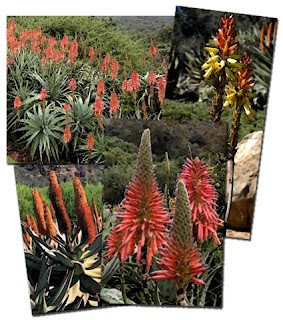
Many of Southern Africa’s Aloe species are about to bloom, attracting bees, butterflies and a vast array of garden birds. Enjoy the spectacle.

Barbara Jeppe described 139 species of Aloe in ‘Aloes of South Africa”. There are aloes flowering somewhere in the region throughout the year. The peak months are June, July and August, the bleakest and driest months for most of southern Africa. In these months the countryside comes alive with thousands of red, orange and yellow blooms of many aloe species, thereby ensuring survival for many bird species.

The larger aloes may have trunks that are partially or fully clothed in old dry leaves. Others are bare and branched like Aloe bainsii, growing to 15m or more in height. The trunk is beautifully striated. The tree aloe makes a handsome garden feature. Aloe arborescens is a dense, many branched shrub aloe. In the Transkei Region of the Eastern Cape province, this aloe has been used to create kraal fence, dense and impenetrable, and an excellent windbreak.

Aloe thraskii is the dune aloe found in KwaZulu-Natal’s dense dune forests, often close to the pounding surf. It is very easy to propagate for seaside homes. Aloe ferox (red aloe) is considered to be a very heavy producer of nectar. An Eastern Cape ornithologist recorded the following bird species visiting Aloe ferox —various sunbirds, black-headed orioles, fork-tailed drongos, weaver birds, pied starlings and  speckled colies. In KwaZulu, Aloe marlothii has been known to attract doves, various tinkers, flycatchers, glossy starlings, canaries, warblers, crombecs, scimitar billed wood hoopoes, babblers, scrub robin, black tit, penduline tit, white-necked raven and yellow throated sparrow.

Aloe candelabrum is a showy aloe in the KwaZulu-Natal midlands. Most of the smaller aloes are stemless and carry less nectar, however, they may be better suited to smaller gardens.  Aloe saponaria, A. chabaudii, and A. pluridens come to mind, the last growing under shade conditions in coastal bush.  A. cooperii, a summer-flowering grass aloe, grows taller under damp conditions. Aloe wickensii, a native of Limpopo Province is possibly one of the most beautiful, which in full bloom appears bi-coloured, the many branched flower spikes like yellow-topped red pyramids.

Many aloe species tolerate a wide range of habitats. Propagation is easy but conditions for their native area should be simulated as much as possible. Grow them from truncheon, cuttings or seed. A branch of A. bainsii, thrust into the ground in situ will take root quickly.

TAKE NOTE

Aloes are protected species and may not be collected from the veld, or sold, without a permit. Offenders face severe fines.

The South African National Biodiversity Institute (SANBI) sells seed and publishes a seed catalogue on its website http://www.sanbi.org. For photos and cultivation information on hundreds of aloes and other indigenous plants, go to SANBI’s plant information website www.PlantZAfrica.com.